We are honored to serve ASRC Federal with their real estate needs across their national portfolio of office and industrial leases. The nature of managing government contracts requires a real estate strategy that aligns with the period of performance while also balancing tenant improvements needed to support the work. Every dollar counts and timing is essential.
Here is what our client David Tender, SVP shared about working with us:
“As SVP and Chief Security Officer at ASRC Federal, I’ve had the distinct privilege of collaborating with Chase and his team in managing our real estate portfolio. I commend Chase for his data-driven approach, in-depth understanding of commercial real estate strategy, and remarkable financial acumen. Chase is a trustworthy partner for any organization aiming for a comprehensive, well-structured approach to portfolio strategy and transaction management. Chase has been a true asset to ASRC Federal! I wholeheartedly recommend him.”
When comparing multiple long-term financial obligations where each option has varied payments over time, it is important to look at the aggregate (total) cost of the liability as well as the Net Present Value (NPV). The NPV allows one to compare different payout schedules (or pay-ins) on the same playing field: What is this worth to me today? or, how much liability would this be in today’s dollars?
In the commercial real estate industry this is done all the time when comparing office leases. For example, if you are a company looking to move into office space (putting aside all other factors; preferred accounting standards, location, amenities, etc…) and you need to compare the costs of the different proposed office leases.
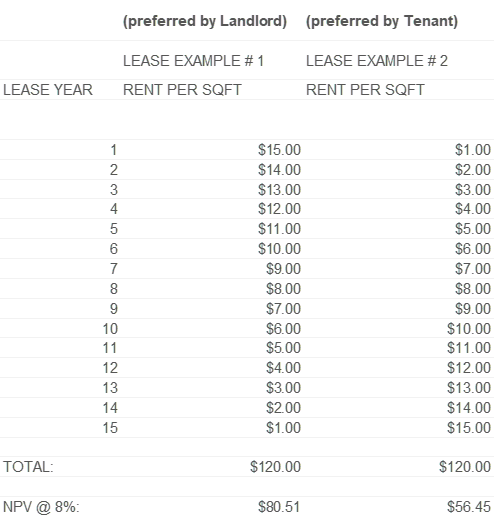
In the example below, I will show you how two deals can cost the exact same on an aggregate basis but when compared on an NPV basis (the value of those deals in today’s dollars) they can be very different. You will also learn which type of deal is preferred, and why, by both Landlords and Tenants.
Although the total amount of rent paid over the entire 15 year period is identical in both examples (i.e. $120.00), the net present values (NPV) are different. Throughout this explanation, ask yourself “who is in possession of more dollars closer to the present time period (now), compared to in the later years” – the Tenant, or the Landlord?
In Example # 1 the Landlord is in possession of more of the rental dollars during the earlier years. In Example # 2, since the Tenant’s rent is initially very low and doesn’t increase to the higher levels until the later years, the Tenant is in possession of more rental dollars during the earlier years.
Why is the NPV of Example # 1 more than the NPV of Example # 2?
In Example # 1 the NPV is more than the NPV in Example # 2 because more rent is being paid to the Landlord during the first 7 Lease Years. Whoever remains in possession of more money earlier in the lease, (either the Landlord or the Tenant) will have the opportunity to invest that money, as they receive it, for a longer period of time.
The Landlord in Example # 2 receives less rent in the beginning of the 15 year period, and because of this, his income cannot compound as significantly as in Example #1. The “upfront” rent paid to him during the early years is much less than it was in Example # 1. In Example #2, the Tenant holds onto more money during the early years and can invest what he doesn’t have to give to the Landlord until the later years.
The concept of NPV takes this time factor into consideration and shows us which alternative is more desirable, even though when summed both deals are equal. From a Tenant’s perspective, you would rather hold onto more money (pay less) over the earlier period of your lease. This would allow the tenant to benefit from the compounding effects of an investment (assumed to grow at 8% per year in this case), while also having the use of the money now.
Why doesn’t the NPV amount when invested at 8% over 15 years equal the Aggregate Value?
The reason that the NPV amount of $80.51 in Example # 1 when invested today at 8% for 15 years does not equal the total dollar amount of $120.00 becomes more evident for the very same reason that the NPV amount of $56.45 in Example # 2 when invested today at the same 8% rate over the same 15 years cannot also equal the same amount of $120.00. How could $80.51 and $56.45 each respectively invested today at 8% for 15 years both end up equaling the same amount of $120.00? This is not possible. The $80.51 invested today upon all of the same terms and conditions as the $56.45 invested today has to have a greater value at the end of 15 years than a lesser amount of $56.45 invested at the same rate for the same period of time.
In Conclusion
As a Tenant, it is important to consider the aggregate cost of a deal because you will need to “write the check” to make the individual payments. But when comparing the varied costs over time, the NPV can help normalize the comparison by taking into account the time value of money. It shows you the cost of any given deal today based on how and when each payout/pay-in occurs.
Financial structures of leases are nearly infinite, and by understanding the concept of NPV enables more creative approaches to how a lease may be structured, or restructured mid-term. One example of this was when escalated lease payments became too high for a client during a period when their business was in transition. The Landlord preferred to keep them as a Tenant and was also looking to refinance his property. We were able to creatively restructure the lease to keep the Landlord “whole” by redistributing the present value of higher lease payments over the term of a new lease while relieving some burden of rental payments for the Tenant. The Landlord was able to hold onto a great Tenant and secure a longer period of operating income to help during the refinance.


 Tenant Real Estate Advisors